
The Sport
Vision impaired table tennis is table tennis you play by ear. The ball has holes in it and crushed bottle tops inside, so it rattles as it moves, and players follow every rally by hearing rather than sight. The game was invented in Australia in 1958, and for most of its history it was known as Swish.
The sport is run in Victoria by the Victorian Vision Impaired Table Tennis Association Incorporated (VVITTA). Anyone can play: blind, low vision or fully sighted, at any age, with no experience needed. The game was designed from the start so that everyone competes on equal terms. Sighted family and friends have played alongside blind and vision impaired players since the sport's earliest years.
The Equipment
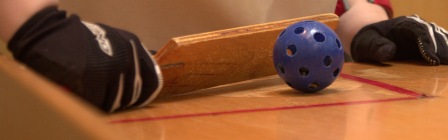
Four things make the game work:
- The table: purpose built, larger and higher than a table tennis table, with raised wooden edges along the sides that keep the ball in play.
- The centre board: a solid wooden board about 75 centimetres tall that stands across the middle of the table in place of a net. It completely hides each player's side from the other, and the ball passes through a gap of about 9 centimetres at its base. It is also called the net.
- The bat: long and flat on both sides, quite unlike a standard table tennis bat. It is worked low against the table so the ball can be pushed rather than hit.
- The ball: the heart of the game. It is about the size of a cricket ball, covered in holes and filled with crushed bottle tops, so players can hear exactly where it is.
Players also wear protective gloves. Clubs provide all of the equipment, so you do not need to bring any of your own.
We also sell balls, bats and gloves to anyone who wants them, and we publish the full table measurements free of charge. See Equipment for Sale and Build a Table.
Playing the Game
The ball never flies. It travels along the surface of the table, skimming through the gap at the base of the centre board, and players follow it entirely by sound. To serve, a player sweeps the ball low along the table with the bat. The receiver listens, stops it and sends it back the same way. A point is won by striking the ball off the end of the opponent's side of the table. The centre board hides everything on the far side, so nobody can see a shot coming. That is the genius of the game: a totally blind player and a fully sighted player compete on genuinely equal terms.
A game is first to 11 points and must be won by two clear points, so close games run past 11. Our score sheets regularly record games of 13 to 11 and beyond. Matches are usually the best of 3 games, and semi-finals and Grand Finals are the best of 5. The game is played as singles or doubles. The score is called aloud throughout play. Umpires and sighted line judges officiate at tournaments, and volunteers help set up the table, guide players and call the scores.
Blindfolds are not part of regular play: players with any level of vision, or none, play together just as they are. Once a year, though, everyone plays completely without sight, at the Margaret Shanahan Blindfold Tournament in February. The first one under that name is on Saturday 6 February 2027. The finer points of the rules are best learned at a club session, where experienced players will walk you through your first games.
Social and Competitive
Vision impaired table tennis is both a social game and a competitive sport. It began as a purely recreational pastime and became competitive over the years, and it is played both ways today. Club members meet for weekly sessions across Victoria. VVITTA runs tournaments through the year at Vision Australia, 454 Glenferrie Road, Kooyong. They include the Nationals qualifiers that take Victorian players to the Australian National Championships. Club delegates also arrange tournaments between their own clubs. See the Events page for what is on this season.
How Tournaments Work
Our tournaments are played as a round-robin, which means everybody plays everybody else in their competition. There are no early exits: whether you win your first match or lose it, you play the same full day as everyone else.
Results go onto a ladder, the table that orders everyone by how they have done. Ladder points are awarded like this:
- 3 points for winning in straight games
- 2 points for winning after losing a game
- 1 point for losing a match you took a game from
- no points for losing in straight games
That way a close loss still counts for something.
If two or more players or pairs finish level on ladder points, they are separated by these, in order:
- the results of the matches between them
- games won minus games lost across all their round-robin matches, worked out per match played
- points won minus points lost, worked out the same way
- if they are still level, a draw of lots
A match won by walkover counts as a win in straight games. The winner takes 3 ladder points and the match goes down as 2 games to nil. The player who did not play takes a loss in straight games. Neither side's point difference changes.
Bigger tournaments finish with semi-finals and a Grand Final, played from the top of the ladder. Some days, such as the Nationals Singles Qualifiers, have no finals at all: the ladder itself decides the result.
Younger Players
Younger players are welcome at our clubs. If you would like to bring a child or a teenager along, please get in touch first, so we can talk through which club suits, what a session is like, and anything your family needs on the day. Telephone the President on 0412 128 429 or email president@vvitta.au. You can also email the Secretary, who is our Child Safety Officer, at secretary@vvitta.au.
How we keep children safe, and how to raise a concern, is in the Child Safety section of our Rules and Policies page.
Coming to Your First Session
You do not need to book, and you do not need to be a member. Your first visits are a chance to try the sport before joining. A small session fee applies at most clubs, so bring a few dollars, and check the session time with the club contact before your first visit. Every club, with its venue, times and contact, is listed on the Where to Play page. If you are not sure where to start, telephone the President on 0412 128 429.
The game's story, from one modified table in a Sydney home for war blinded veterans to clubs across Victoria, is told on the Our History page.
Common Questions
Is This the Same as Swish, or Blind Table Tennis?
Yes. Vision impaired table tennis was known as Swish for most of its history, and many people call it blind table tennis. They are all the same game. In Victoria it is run by the Victorian Vision Impaired Table Tennis Association Incorporated (VVITTA).
Where Can I Play in Melbourne?
There are weekly sessions at Kooyong, Dandenong, Brunswick and Coburg, Frankston, Boronia and Mooroolbark, and Keilor. The Kooyong club plays at Vision Australia, 454 Glenferrie Road, Kooyong, on Saturdays from 1:00 PM to 4:00 PM. Outside Melbourne there are sessions in Geelong, and programs associated with Vision Australia run in Mildura and Bendigo. Session details change from time to time, so check the Where to Play page before you go: it has each club's venue, day and contact.
Do I Need to Be a Member to Try It?
No. You can come along and try the sport before you join. Membership is $20 for the 2026 to 2027 season, renewing on 1 July, and you can join online.
Do I Need My Own Equipment?
No. Clubs provide all of the equipment, so you do not need to bring any of your own. If you would like your own, we sell balls, bats and gloves.
Can Sighted People Play?
Yes. Anyone can play: blind, low vision or fully sighted, at any age, with no experience needed. Everyone competes on equal terms.
How Do I Get Started?
Telephone the President, Marco Curralejo, on 0412 128 429, or email president@vvitta.au, and we will connect you with your nearest club.